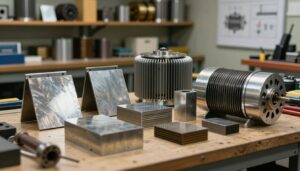
Core Design of a Transformer: Concepts, Types, and Applications in Real Life
Transformers are the primary components of a power system. From the transmission of electricity to various machines in industries and renewable energy sources, the performance of a transformer depends heavily on one essential component—the core.
The core design of a transformer directly affects its efficiency, losses, size, and overall life.
A discussion of the core design of a transformer helps explain why some transformers have longer lifetimes, better performance, and lower energy losses than others.
Importance of the Transformer Core
The transformer core serves as a low-reluctance channel for the magnetic flux generated by the windings. This well-guided magnetic path is one of the factors that make energy transfer from the primary to the secondary winding of the transformer highly efficient. Good design of a transformer core contributes to reduced losses, improved voltage regulation, and overheating prevention.
The efficient functioning of a transformer in actual environments is largely influenced by the design of the transformer core, its material, and its quality.
Basic Concepts of Transformer Core Design
Transformers operate on the system of electromagnetic induction. A fluctuating magnetic field is produced when an alternating current passes through the transformer’s primary winding.
This magnetic field is guided by the transformer core to induce a voltage in the secondary winding.
The magnetic flux must be distributed correctly. When the transformer core becomes saturated, meaning it cannot carry any more magnetic flux, the transformer’s efficiency decreases, and it produces a lot of heat.
There are two significant sources of loss in the core design of a transformer:
Hysteresis losses, which occur due to the repeated magnetisation and demagnetisation of the transformer core material
Eddy current losses, which are produced by the circulating currents in the transformer core itself
The use of laminated cores and appropriate magnetic materials helps reduce losses significantly.
Types of Transformer Cores
There are three major types of transformer cores, each best suited to a particular application.
Core-Type Transformers
In this type, the windings are placed around the core limbs. Core-type transformers are quite simple and economical. They are widely used in power distribution and industrial applications.
Shell-Type Transformers
In this type, the core is placed around the windings. This type of transformer core provides better magnetic shielding and reduced leakage flux. It is best suited for high-voltage and noise-free applications.
Toroidal Core Transformers
In toroidal core transformers, the core is in the form of a circular doughnut. This type of transformer core provides the highest efficiency, lowest leakage flux, and noise-free operation. It is best suited for medical applications, audio systems, and precision electronics.
In these three types of transformer cores, toroidal cores provide the highest efficiency, followed by shell-type transformers and then core-type transformers.
Transformer Core Materials and Their Properties
Material selection is an important aspect of transformer core design.
Silicon Steel (CRGO and CRNGO)
Cold-rolled grain-oriented (CRGO) steel is widely used in power transformers because of its superior magnetic properties in a particular direction. Applications involving multidirectional magnetic flux use CRNGO steel.
Cores of Amorphous Metals
Transformer cores made of amorphous metal are very efficient and have low core losses. They work best in distribution networks and energy-efficient transformers.
Ferrite and Nanocrystalline Materials
Ferrite transformer cores are best suited for high-frequency applications. Nanocrystalline materials have low losses and high magnetic permeability. They are best suited for compact and high-performance transformers.
Operating Frequency, Efficiency, and Cost
Operating frequency, efficiency, and cost are important factors in material selection for transformer cores.
The core dimensions and cross-sectional area define the efficiency of the magnetic flux in the transformer. Thin laminations are used to reduce eddy currents, and proper stacking increases magnetic efficiency.
Another important factor is cooling. The transformer’s lifespan may be shortened by ineffective cooling. Techniques for reducing noise, like vibration and tight clamping, also improve the transformer’s efficiency.
Reducing Core Losses in Transformers
The transformer’s efficiency can be raised by reducing core losses. This reduces the operational cost of the transformer. New materials, such as amorphous and nanocrystalline materials, have reduced the hysteresis losses. New lamination processes have also reduced the eddy currents.
Efficiency norms set by regulatory authorities promote the use of low-loss transformer cores. This is beneficial to both consumers and power companies, as it reduces energy consumption.
Real-World Applications of Transformer Core Designs
Transformer cores are used in power distribution systems to distribute electricity over long distances. Industrial and commercial power systems use strong transformer cores that can withstand mechanical and thermal stresses.
Renewable energy systems, such as wind and solar power plants, use special transformer cores to handle changing loads efficiently. In addition, electric vehicles use compact, high-efficiency transformer cores for both charging and power conversion.
Future Trends in Transformer Core Design
Transformer core design is an emerging field, driven by advances in materials and manufacturing processes. The growing need for renewable energy, electric vehicles, and energy-efficient power grids has increased demand for compact, low-loss transformer cores.
Advances in amorphous and nanocrystalline core technology are defining the future of transformer efficiency, sustainability, and performance. This makes transformer core design more important than ever in electrical engineering.

